By the Insulation System team, Lahore. Last updated: November 2026.
In a Lahore summer, the water that comes out of your “cold” tap can be warm enough to wash with. The pipes run across a roof that bakes in the sun all day. In the same house, the copper lines of your AC drip water onto the wall. Up north, a pipe left bare in January can freeze and split.
All of these have the same fix: pipe insulation, also called insulation pipe or pipe lagging. It is a jacket of foam or fibre that slows heat moving in or out of the pipe. This guide explains the main types, which one suits which job, how thick it should be, and the mistakes that waste your money.
What pipe insulation actually does
- Keeps temperature. Hot lines stay hot longer. Cold lines stay cold instead of warming up on the roof.
- Stops sweating. A cold pipe in warm, humid air collects water droplets. Insulation keeps the pipe surface warmer than the dew point, so the dripping stops. This protects ceilings and walls.
- Protects the pipe. It cushions against knocks and slows freezing in cold areas.
- Saves energy. A bare chilled line or AC line wastes cooling. Insulating it lets the AC do the same job with less work.
Types of pipe insulation used in Pakistan
There is no single best material. Each one is good at a different job.
| Type | Best for | Typical temperature range | Good to know |
|---|---|---|---|
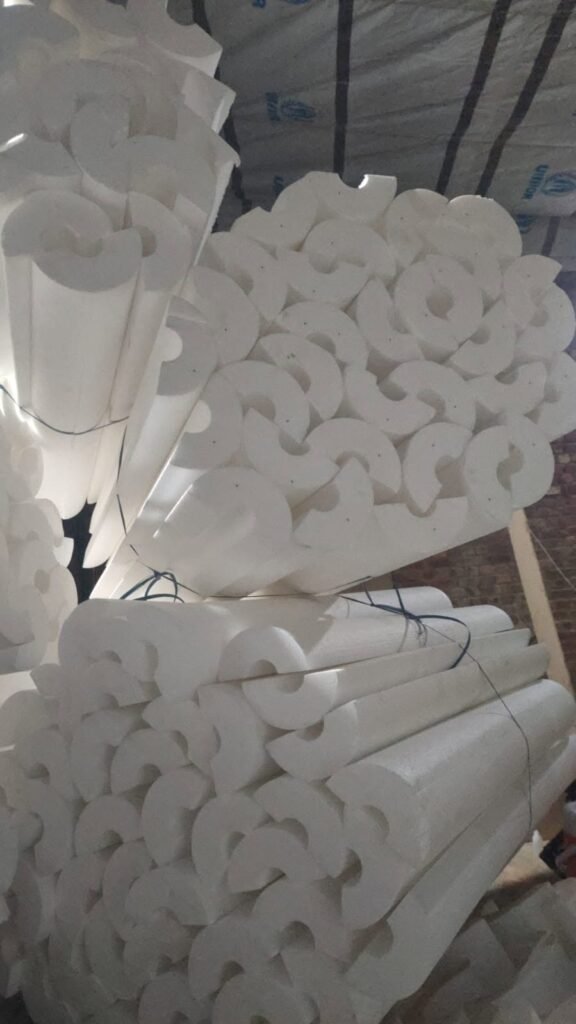
| EPS / Thermopore pipe sections | Cold and chilled water lines, roof water pipes, drain lines | About -50°C to +70°C | Rigid and light. Low cost. Not for steam or very hot lines. More on thermopore pipe |
| NBR foam (Armaflex or Aeroflex style) | AC copper lines, chilled water, bends and tight spaces | About -50°C to +105°C (varies by product) | Flexible, closed-cell, resists moisture. Costs more than EPS. |
| PE foam | Light-duty AC and household lines | Lower limit than NBR | Cheapest flexible option. Less durable outdoors. |
| Glass wool pipe sections | Hot water and steam lines | Roughly 230 to 250°C, depending on grade | Needs a foil or cladding jacket. Keep dry. |
| Rock wool pipe sections | Boilers, steam, industrial heat | Much higher, depending on grade | Used in factories more than homes. |
Temperature ranges are typical for each material type. Always check the datasheet of the exact product.
Which pipe insulation for which job?
| Your pipe | Use |
|---|---|
| AC copper line set (split AC) | NBR foam, or PE foam on a tight budget. AC pipe insulation guide |
| Cold water pipe on a roof or in a ceiling | EPS pipe sections or NBR foam, with a UV-safe cover. Water pipe guide |
| Hot water pipe from a geyser | NBR foam or glass wool, depending on temperature |
| Chilled water pipe (building AC) | NBR foam or EPS with a vapour barrier and cladding |
| Steam or hot oil line | Glass wool or rock wool. Not EPS. |
| Cold room refrigerant lines | NBR foam; see cold storage insulation |
Not sure which side you fall on? Our comparison of NBR foam, EPS and glass wool goes into more detail.
How thick should pipe insulation be?
Three things decide thickness:
- Temperature difference. The bigger the gap between the pipe and the air, the more insulation you need.
- Pipe size. A bigger pipe has more surface to lose or gain heat.
- Where it runs. Outdoors, in a hot ceiling void, or in humid air all call for more.
Common thickness by job
| Job | Common thickness | Note |
|---|---|---|
| Split AC copper lines at home | 9 to 13 mm | 13 mm is the most common. 9 mm suits short runs and tight spaces. |
| Refrigeration and low-temperature lines | 19 mm | Needed where 13 mm cannot stop condensation. |
| Household hot and cold water pipes | 13 to 25 mm | Use the thicker end for roof lines in full sun. |
| Chilled water pipes (6 to 12°C) | At least 25 mm for pipes up to 28 mm | 32 to 38 mm is safer against condensation. Large mains often need 50 mm. |
| Commercial HVAC and high-spec jobs | 25 mm | Check the project specification. |
| Industrial and heavy-duty lines | 32, 40 or 50 mm and above | Needs a proper calculation. |
Thickness ranges follow common manufacturer and supplier guidance. Exact figures depend on pipe size, fluid temperature and humidity.
Common sizes and lengths
| Type | Usual length | Common thickness | Pipe sizes |
|---|---|---|---|
| NBR foam tube | 2 m | 9, 13, 19, 25 mm (32 mm and above for industrial) | About 6 mm up to 89 mm bore, chosen to match the pipe’s outside diameter |
| PE foam tube | 2 m | 9, 13, 19, 25 mm | Mostly 15 to 28 mm household lines |
| EPS (thermopore) pipe section | 1 m, sometimes up to 2 m | Commonly 20 to 100 mm | From about 15 mm to several hundred mm, density about 14 to 30 kg/m³ |
| Glass wool pipe section | 1 m | 19, 25, 38, 50, 63 mm | By nominal bore |
| Rock wool pipe section | 1 m | 25 to 150 mm | Custom diameters |
These are typical market ranges. For what we cut and supply, send us your pipe diameter and we will confirm.
Not sure which thickness fits? Send us the pipe diameter, the fluid temperature and where the pipe runs, and we will suggest one.
Five mistakes that waste money
- Leaving gaps at joints and bends. Heat and moisture get in through the gaps. Seal every joint with tape.
- Squeezing the insulation. Compressed foam insulates less. Cut it to size.
- Using EPS on a hot line. EPS softens above its temperature limit. Use fibre or NBR for hot lines.
- Leaving outdoor insulation uncovered. Sun and weather break down foam. Cover it with foil, tape or cladding.
- Insulating before testing. Pressure-test and check for leaks first.
EPS (Thermopore) pipe insulation from Insulation System
We make EPS thermocol sheets at our factory in Gopi Rai, Lahore, and we cut and supply thermopore pipe sections for cold and chilled lines, made to your pipe diameter and thickness. See the sizes and thickness table. We do not recommend EPS for steam or very hot pipes, and we will tell you if another material suits your job better.
Frequently asked questions
Send pipe size, length and where it runs. WhatsApp or call +92 300 3679943. A quote usually comes within about 30 minutes. Get a quote
