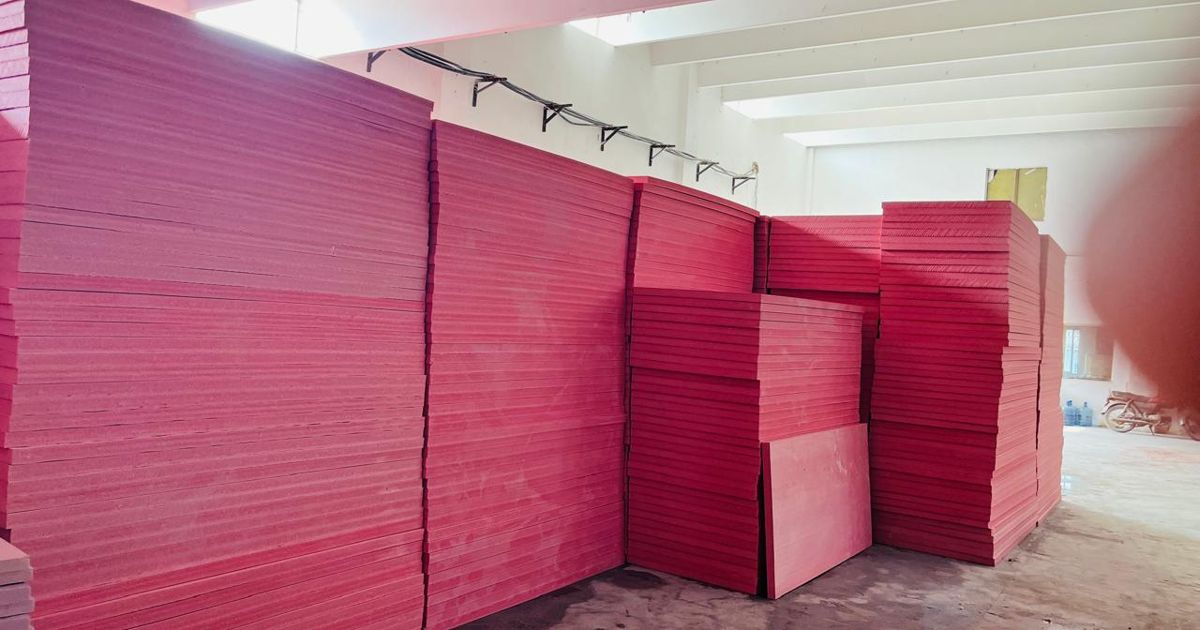
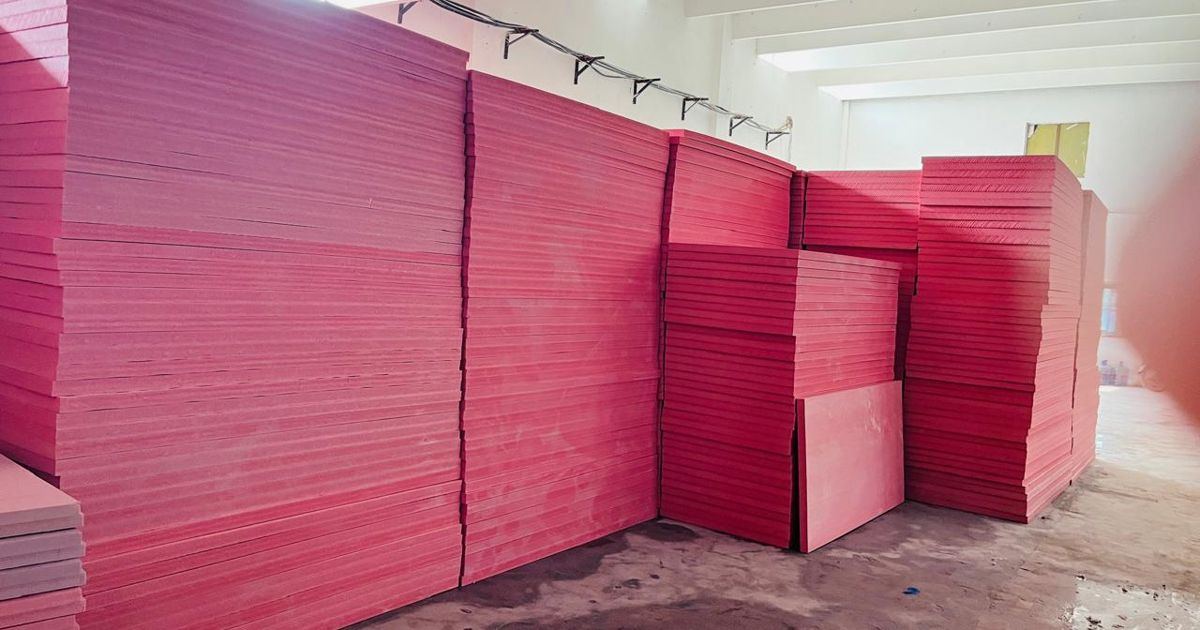
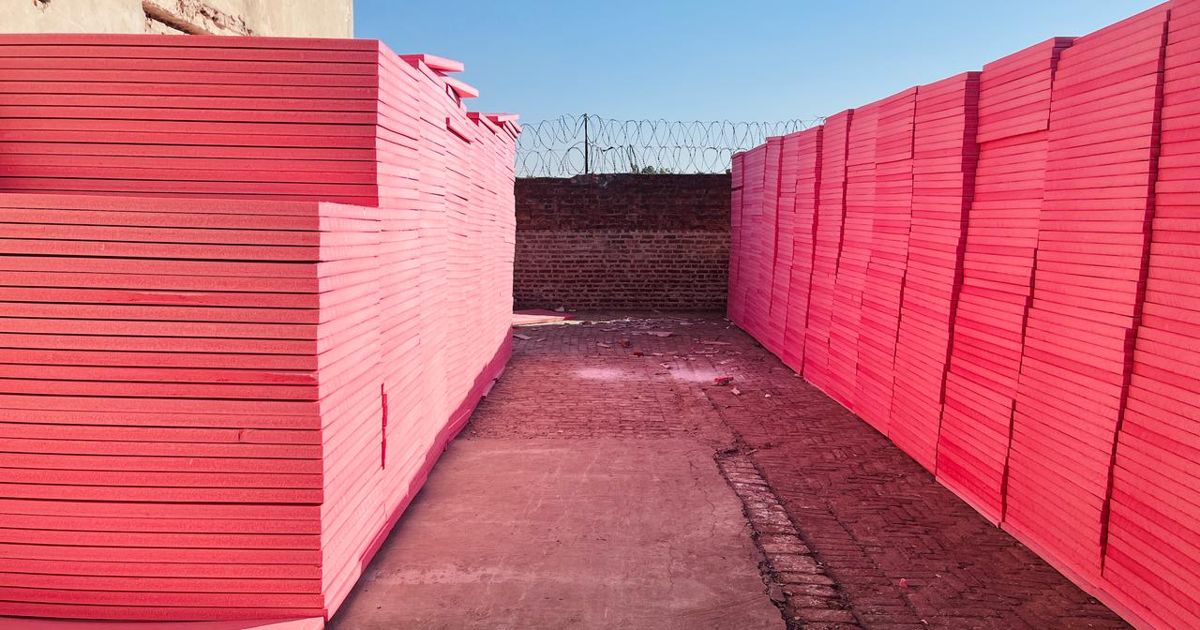
For most house roofs in Pakistan, buy 2 inch Jumbolon (XPS) boards. Use 1 inch for floors and light walls, 3 inch for walls and cold rooms, and 4 inch for cold storage and heavy insulation. Our standard sheet is 3×6 ft, which covers 18 sq ft, and we cut custom sizes up to 6 inch thick. Thicker is not always smarter: the first two inches do most of the work, and the next two cost a lot more for a smaller gain. Match the thickness to the job, not to the biggest number on the price list.
Why thickness matters more than the brand name
Two boards from the same factory can behave very differently on your roof, and the main reason is thickness. Insulation works by slowing heat down. The thicker the layer, the longer heat takes to get through, so thickness is the number that actually decides how cool your rooms stay. Density and strength matter for how the board survives on the roof, but thickness decides how well it insulates.
That is why a shop that sells you “Jumbolon” without telling you the thickness has told you almost nothing. Ask for the inches first.
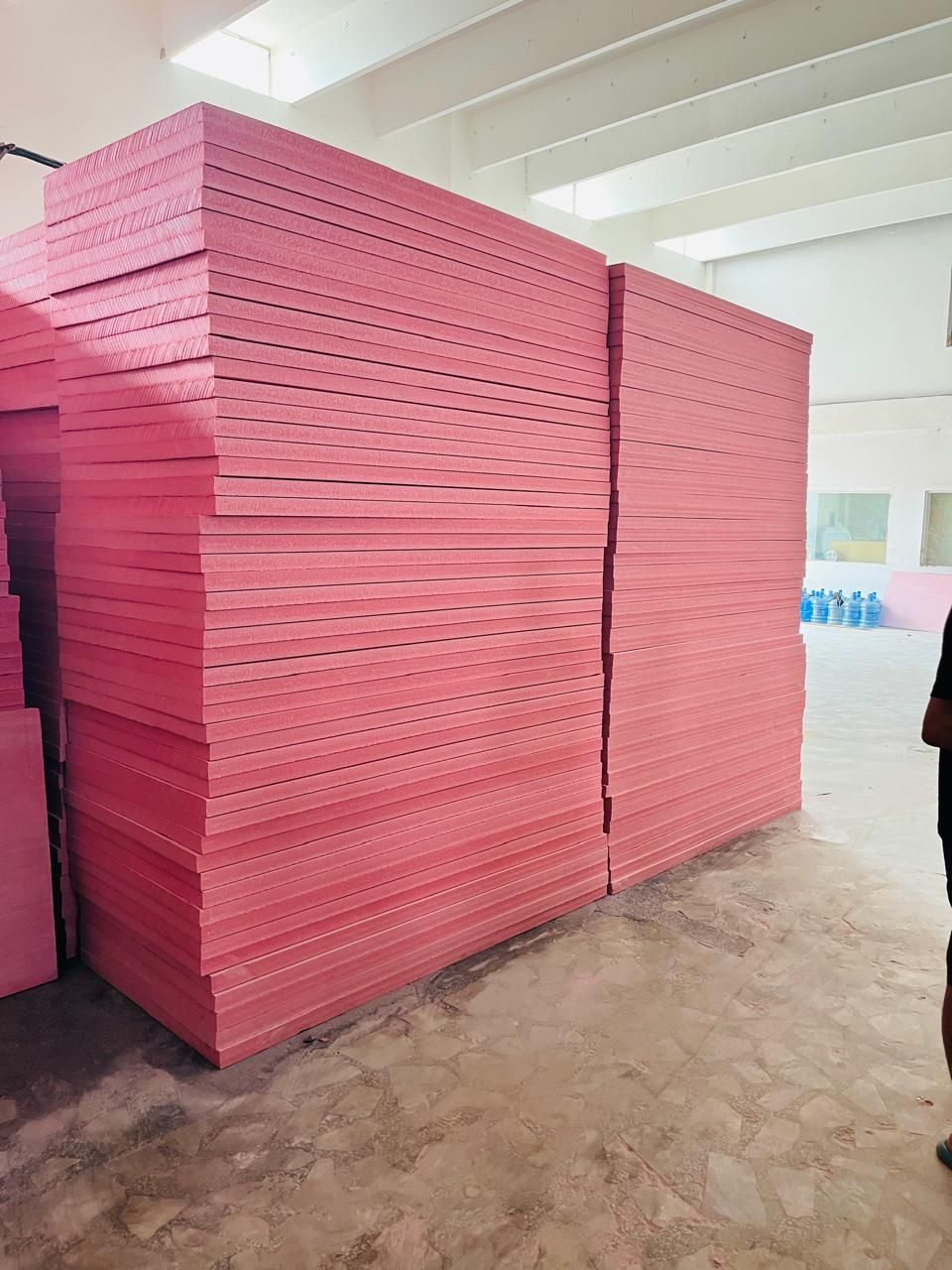
Which thickness for which job
| Use | Typical thickness | Why |
|---|---|---|
| House roof, under screed | 2 inch | Best balance of cost and heat blocking |
| Large or very exposed roof, factory | 3 inch | A big surface takes in more heat, so extra thickness pays back |
| External or cavity wall | 1 to 2 inch | Limited by plaster build-up and wall depth |
| Internal wall, partition | 1 inch | Room space is limited |
| Floor, slab | 1 to 2 inch | Under screed in air-conditioned rooms |
| Cold room, cold storage | 3 to 4 inch | Thickness depends on how cold the room is |
| Basement, foundation | 2 inch | Needs XPS because of constant moisture |
These are typical choices. Your building may need something different, and a quick photo of the roof on WhatsApp is often enough for us to say.
What each inch gives you
XPS gives about R-5 per inch. So 1 inch is about R-5, 2 inch about R-10, 3 inch about R-15 and 4 inch about R-20. Here is what that costs on our 3×6 ft sheets:
| Thickness | About R-value | Price per sheet | About per sq ft |
|---|---|---|---|
| 1 inch | R-5 | Rs 1,200 to 1,800 | Rs 67 to 100 |
| 2 inch | R-10 | Rs 2,200 to 3,200 | Rs 122 to 178 |
| 3 inch | R-15 | Rs 3,500 to 4,800 | Rs 194 to 267 |
| 4 inch | R-20 | Rs 5,000 to 6,500 | Rs 278 to 361 |
Now look at what the extra thickness really buys. Considering the insulation layer on its own, heat flow is inversely proportional to the R-value. Going from 1 inch to 2 inch halves the heat passing through the layer. Going from 2 inch to 3 inch cuts it by a further third. Going from 3 inch to 4 inch cuts it by a further quarter. Each step costs more and gains less. In real buildings the gains are smaller still, because the slab, the screed and the air around them add some resistance of their own. This is why 2 inch is the sweet spot for homes.
Sizes: what we stock and what we cut
Our standard Jumbolon sheet is 3×6 ft (18 sq ft) in 1, 2, 3 and 4 inch thickness. We also cut custom sizes up to 6 inch thick, which is useful for cold rooms, factory roofs and odd-shaped terraces. If your roof has a water tank, a staircase and an AC stand to work around, send the dimensions and we can cut boards that fit, so you are not paying for foam you will trim off and throw away.
How many sheets does your roof need?
The formula is simple: roof area in square feet divided by 18 (one 3×6 ft sheet), rounded up, plus 5 to 10% for cutting waste. One marla is about 272 sq ft.
A 5 marla roof is about 1,361 sq ft, so about 76 sheets plus waste. A 10 marla roof is about 2,722 sq ft, so about 152 sheets plus waste. For the 5 marla roof, the sheets alone cost roughly:
| Thickness | Sheets | Cost of sheets (5 marla roof) |
|---|---|---|
| 1 inch | about 76 | Rs 91,000 to 137,000 |
| 2 inch | about 76 | Rs 167,000 to 243,000 |
| 3 inch | about 76 | Rs 266,000 to 365,000 |
| 4 inch | about 76 | Rs 380,000 to 494,000 |
These are the boards only. Screed, waterproofing and labour are extra. If your budget is tight and the roof is dry, remember that 2 inch thermocol covers the same roof for roughly Rs 41,000 to 47,000. Our Jumbolon vs Thermopore comparison explains when each one makes sense.
Roof thickness by city
The default is 2 inch everywhere, and you move up or down from there.
Lahore and Multan. Long, hot summers and strong afternoon sun on the roof. Two inch is right for a normal house. Go to 3 inch for a big top floor with large exposed roof, or for a shop or workshop with a lot of heat inside.
Karachi. The weather is humid and the roof sees rain and salt air. Two inch works for most houses, and this is a good place to pick XPS over EPS because moisture is a daily factor.
Peshawar and the north. Hot summers and cold winters, so insulation helps in both seasons. Two inch is the usual choice. Thicker pays back mostly on roofs that heat or cool a large space.
Walls, floors, cold rooms and basements
On walls, the board is not the limit. The plaster build-up and the length of the fixings are. One to two inch is common. Check with your engineer before going thicker. On floors, 1 to 2 inch under the screed is typical in rooms that you air-condition. For cold rooms, 3 to 4 inch is normal, and the exact number depends on the room temperature, so tell us the size and the target. For basements and foundations, 2 inch XPS works because XPS keeps its performance in permanent dampness, where EPS does not.
When thicker stops making sense
Before you order 4 inch for a house roof, check three practical limits. The first is height: a thicker board plus screed raises the roof surface, and that can clash with door thresholds, parapet height and the water tank base. The second is weight: more screed over thicker boards adds load to the slab. The third is budget: that same money often buys better waterproofing or a second job, such as insulating the west wall.
Common mistakes
Using 1 inch on a roof and expecting the same result as 2 inch.
Choosing thickness without asking about density and compressive strength.
Forgetting that XPS is not a waterproof layer: the roof still needs waterproofing.
Leaving gaps between boards, which lets heat bypass the insulation.
Ordering by thickness and sheet size only, with no allowance for cutting waste.
Send your roof size on WhatsApp and we will tell you the thickness and the sheet count. See current rates on our Jumbolon sheet price page.
Insulation System, Gopi Rai Road, 3 km Katar Band Road, Gopi Rai, Lahore 53700. Phone and WhatsApp: +92 300 3679943. Email: Insulationsystems.eps@gmail.com. Open 24 hours. Find us on Google Maps.
Related Jumbolon and insulation guides
Explore our related solutions
Jumbolon Sheet Price • XPS Insulation Boards • Thermocol Sheet • Insulation Material in Pakistan • Get a Free Quote