Home / Services / Sandwich Panel Insulation
EPS & Jumbolon Core Material for Sandwich Panel Walls — Pakistan 2026
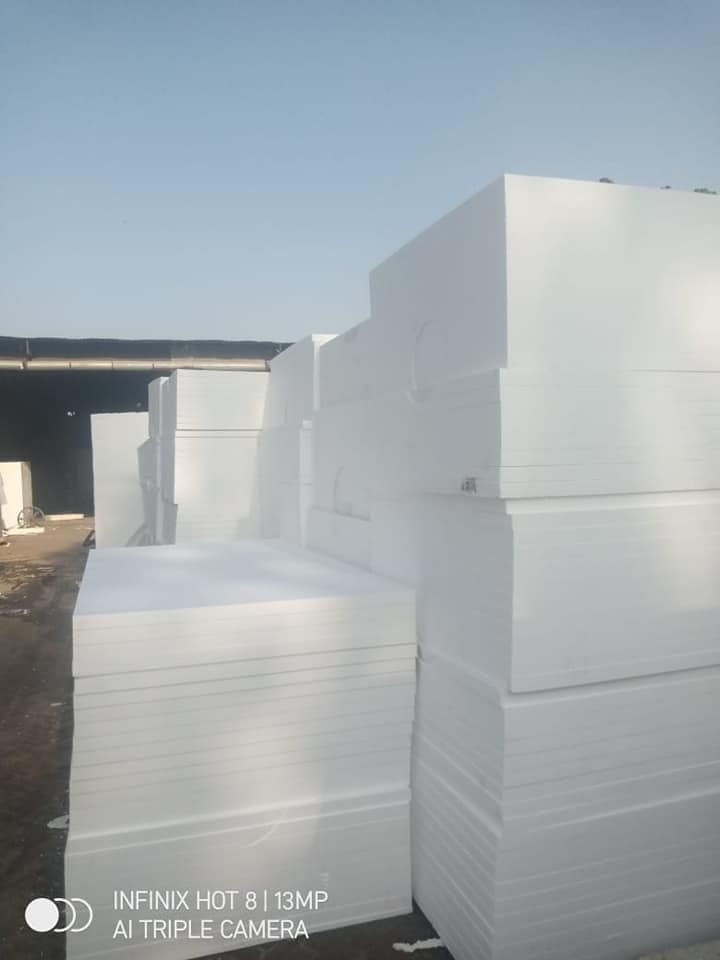
A sandwich panel is really just a name for an insulation core sandwiched between two facing surfaces. We supply the EPS and Jumbolon (XPS) core sheets that go into that build-up — for builders constructing insulated cold room walls, partition walls, and shed cladding on site in Pakistan.
WHAT "SANDWICH PANEL" ACTUALLY MEANS
Let's Be Clear About What We Supply
A “sandwich panel” is a construction term for any wall or roof build-up where an insulation layer sits in the middle, between two outer surfaces — like a sandwich. Big industrial suppliers run factory lines that roll-bond steel or aluminum skins directly onto a foam core, producing one finished, ready-to-bolt-on metal panel. That’s a specific, capital-heavy manufacturing process.
What we supply is the core material — EPS Thermocol and Jumbolon (XPS) sheets — cut to the size and density your project needs. Builders and contractors use these as the insulating layer in cold room walls, partition walls, ceilings, and shed cladding, fixed between cladding sheets or masonry on site. It’s a more flexible and affordable approach for most site-built projects.
Why Site-Built Beats Factory Panels for Most Projects:
- No minimum order tied to a factory production run
- Cut to your exact wall dimensions, not fixed panel widths
- Choose EPS or Jumbolon density independently for each part of the build
- Significantly cheaper than imported pre-fabricated metal sandwich panels
CHOOSING THE CORE MATERIAL
EPS or Jumbolon Core — Which One for Your Wall Build-Up?
🧱 EPS Thermocol Core
The standard choice for partition walls, false ceilings, and dry-area shed cladding. Affordable, easy to cut to size on site, and performs well as long as the build-up isn’t exposed to constant moisture.
- Best value for dry-area walls and partitions
- Densities from 16–25 kg/m³ depending on the load
- Choose Jumbolon instead for constant-moisture areas
🟦 Jumbolon (XPS) Core
The right call for cold room walls and any build-up that will see ongoing condensation. Higher R-value per inch means a thinner core can match what a thicker EPS core would need.
- Water absorption under 0.3% — holds its R-value for years
- Best for cold room walls, below-grade, and wet-area builds
- Higher compressive strength for load-bearing panel sections
What we usually recommend: EPS core for general partition walls, false ceilings, and dry shed cladding. Jumbolon core for cold room walls and anywhere the build-up will sit against condensation long-term.
What Are You Actually Trying to Quiet Down?
Recording Studio or Home Theater
Go with glass wool or rock wool panels on walls and ceiling. This is the one application where EPS genuinely isn’t the right tool for the job.
Office Partition Walls
Glass wool inside partition cavities cuts down conversation noise between rooms far better than foam board alone.
Bedroom Near a Busy Road
If heat is also a problem, EPS or PU Foam on the roof gives you cooling plus a modest noise dampening bonus — a reasonable two-birds option.
Factory or Generator Room
Rock wool is the standard here — handles both the noise and the heat from machinery, plus it’s fire-resistant around hot equipment.
Poultry Shed Near Residential Areas
EPS roof insulation (which you likely need anyway for temperature control) plus rock wool wall lining if noise complaints are an issue.
Cinema, Event Hall, or Auditorium
Rock wool acoustic panels combined with proper wall framing — this is a job worth getting an acoustic-specific recommendation for, not a generic insulation order.
Common Questions About Sandwich Panel Core Material
We supply the insulation core — EPS Thermocol and Jumbolon (XPS) sheets — cut to the size and density your project needs. We don’t run a factory line that bonds metal skins to foam to produce a finished, ready-to-bolt-on panel. Our material is typically fixed between cladding sheets or masonry on site by your contractor, which works out more flexible and affordable for most small-to-mid sized projects.
Building an Insulated Wall or Cladding System?
Tell us your wall type, dimensions, and whether it’s a dry or cold-room application — we’ll recommend EPS or Jumbolon and the right thickness.
